
[PAPER DRAFT] Linked Digital Dynamics: An observer referential framework for co-constructive optimism
THE READING PLAQUE. Linked Digital Dynamics: An observer referential framework for co-constructive optimism — the one citable Reference of Linked Digital Dynamics, draft 0.2: the definitive, axioms-first statement of the framework, readable on the SX surface by its covering persona's reading grant; not an externally published form. Covering: starl3n · endorsing: Link Digital · the author of record: De Costa, S (2026). The lifecycle honored in sequence: the diode on the workshop; the analysis sealed with the operator's seven resolutions; the plan; draft 0.1 on his word; his five-finding review; this 0.2. THE NAMING ACT (2026-08-06), his: the title above — the working handle (Linked Digital Dynamics: The Reference) superseded and retained in the record. The grant: the operator's word — "I'm happy with this edition to hit the SX reading surface. Please apply a reading grant." This Reference supersedes A Field Guide to Linked Digital Dynamics for citation. The standing no-claims, verbatim in substance: LDD makes no claims regarding physics, and claims nothing except the specific claims constructed via the experimentalist's own process; LDD holds neither class nor type nor run of reason to be inherently superior or vital. The plates and the workbook's hash-pinned archived export are served beside this page (under /sx/assets/ldd/). The intended external act — the ResearchGate pre-print with a DOI investigated — lands by its own later word, its footnote landing back on this record. This file's sha256 is pinned in the reading register. Reading is free; the way across is a statement of intent (/sx/matters).
Linked Digital Dynamics: An observer referential framework for co-constructive optimism
De Costa, S. (2026)
Abstract
Linked Digital Dynamics (LDD) is a framework for constructing knowings from discrete synthetic sets under strict confinement. Its conjecture reads reality for an observer as the unit: 1 = O + C + E — what is observable, plus what is communicable, plus what is effectual. The framework licenses claims only through the experimentalist's own process — a causal apparatus, a digital ontology, and a synthetic agreement — and makes no claims regarding physics. From the conjecture applied to discrete linearity under confinement, LDD derives a bifurcation cascade whose effect-sequence is the signed Jacobsthal sequence; the cascade derives the geometry the founding materials had posited; and from that geometry a family of emergent constructs is earned inside the record's own experimental worlds, each observable, communicable and effectual, none claimed beyond its apparatus. This Reference states the axioms, the derivations, the disciplines, and the reading of the experimental Canon from them. It supersedes A Field Guide to Linked Digital Dynamics for citation.
Standing notes
- Supersession. This Reference supersedes A Field Guide to Linked Digital Dynamics (the seed document) for citation. The seed stands as history; its formulations are restated here in their matured form.
- The process license. LDD makes no claims regarding physics, and claims nothing except the specific claims constructed via the experimentalist's own process (§3). Every term in this document names a model-internal object.
- The neutrality clause. LDD holds neither class nor type nor run of reason to be inherently superior or vital. Where other authors use LDD to discuss such qualities, the discussion is their own (§3).
- Dating. The living workbook cited in the references was not made public until August 2026, though it represents citable works dating to earlier periods.
§1 · The conjecture
The conjecture (De Costa) is that reality, taken for an observer as the unit, decomposes exactly:
1 = O + C + E
where O is what is observable — the state that stands readable within a frame; C is what is communicable — the account that can be carried between frames; and E is what is effectual — the differential that changes the account (RK-1, RK-2). The three terms are defined terms, not metaphors: in every construction below they are integers or exact rationals in a declared bookkeeping, and the identity is readable from either side — 1 = O + C + E and O + C + E = 1 are the same statement of the same unit.
The unit is reality for an observer. LDD does not assert that the world at large sums to anything; it asserts that an observer's reality, synthetically confined and honestly bookkept, can be held to this identity and that the holding is productive — the whole framework is the demonstration.
The first matter of knowing, in LDD, is discrete linearity itself. The ordered step — the count, the successor, the line of integers — is not taken as an inherited backdrop but as the first object of study: what does the linear, discrete progression do when it is confined and made to carry the conjecture? Everything in this Reference descends from that question, pursued in the field the framework's own practice has come to name applied Synthetic Set Dynamics: the construction and operation of small, exact, fully declared synthetic sets whose dynamics are run, read and recorded rather than assumed.
§2 · The Zero
The zero of the conjecture is not nothing (RK-3). It is the non-differentiating boundary between the effectual observer's reality and the objective observer's reality — a void defined by the equivocation and agreement of a constrained definition of the effectual observer's reality. The seed stated it as "a volatile and multiphased space… defined as being void of net differentials over a periodicity of confined differential measurement," and the matured record keeps that sense as one definition: Zero is where confined differential measurement, summed over its own periodicity, nets to nothing — not where nothing is.
Zero is itself subject to the externality of the conjecture: it is never claimed as ground. Every construction in this Reference is calibrated to this zero, and the discipline that follows from refusing to ground on it — the permanent externality (§9) — runs through the whole record.
§3 · The process license
LDD's claims-discipline is itself an axiom of the framework, not a disclaimer attached to it (RK-4). The seed's closing section, A Tactical Conclusion, states it: the matter of proof falls to each of us to accept one's own autonomy; the burden of conducting one's own experimentation is the dependent remainder of conjecture. In practice:
- LDD makes no claims regarding physics. Its objects are synthetic; its constants are earned inside declared apparatus; its vocabulary, where it echoes physical language, names model-internal objects only.
- LDD claims nothing except the specific claims constructed via the experimentalist's own process. That process has three required components: a causal apparatus (an autonomous agent — the experimentalist); a digital ontology (code, data and explanations — the autonomous substrate); and a synthetic agreement (the conjecture itself, expanded or contracted to correctly parametrise the experiment).
- The burden of proof is the practitioner's own. A reader does not inherit LDD's knowings; they conduct their own experiments and earn their own. The Reference exists so that the conducting has a clear statement to proceed from.
Beside the license stands the neutrality clause (RK-5): LDD holds neither class nor type nor run of reason to be inherently superior or vital. The framework describes construction and confinement; it ranks nothing. Where another author applies LDD to questions of quality — of one kind of reasoning against another, of vitality, of worth — the application is entirely reasonable and entirely that author's own; it is not native to the framework and nothing in this Reference supports or opposes it.
§4 · The confinement sequence
The founding experiments confine the conjecture in sequence (RK-6, RK-7, RK-8). Each holds an orthogonal view over a singularity: the one reality, viewed under a constraint that denies it differentiation, and read for what the denial produces.
- Dyadic confinement: 1 = 0. The unit held where no differential is admitted. Under the orthogonal view the identity does not vanish; it localizes — the observer's reality and the boundary coincide, and the first knowing is that the coincidence is readable (localization under causal relativity).
- Triadic confinement: 1 = 0 + 0. The unit held across is and was: two non-differentiating terms whose distinction is temporal only. The differential that will not appear in either term appears between them.
- Quadratic confinement: 1 = 0 + 0 + 0. The unit held across is, was and may: the containment written in full, and the form the cascade will take as State 0 (§5).
The seed conducted five founding experiments — the three confinements, the measurement solution over five bifurcations, and the quantic projection of confinement — each with its causal context, its ontology and its synthetic agreement declared. The matured restatement of their origin displays is the one this Reference carries throughout: the identity readable from either side, and collapse admitted only as the joint annihilation O = C = E = 0 — which is not a vanishing of the unit but the containment itself, State 0, from which the cascade releases the effect. No form of the origin in which the unit degenerates is part of the framework.
§5 · The cascade
State 0 is the conjecture confined: 1 = (0, 0, 0), the containment (§4). Subjecting the contained reality to the stress of bifurcation releases the effect, and the release follows a fixed rule (RK-9): what was effectual becomes observable (memory: O takes the prior E); what is observable is communicable (presentism: C = O); and the effect balances the unit (E = 1 − O − C):
| state | O | C | E | reading |
|---|---|---|---|---|
| 0 | 0 | 0 | 0 | the containment |
| 1 | 0 | 0 | 1 | the externality of 1 becomes memory |
| 2 | 1 | 1 | −1 | O ← prior E; C = O; E balances |
| 3 | −1 | −1 | 3 | |
| 4 | 3 | 3 | −5 | |
| 5 | −5 | −5 | 11 | the onto-epistemic register shift |
Every state sums to 1. The E-sequence is the signed Jacobsthal sequence, with abs(Eₙ) = (2ⁿ − (−1)ⁿ)/3 (RK-10): the dyadic (×2) confined by the triadic (/3), alternating sign — two forward, one back. Its fixed point is E* = 1/3, with O + C → 2/3 (RK-11): the equilibrium of the conjecture, in the generator ratios that keep two thirds and trade the middle third. (The record's tenth experiment later measured the substrate's own beat as 1 = 0.75 memory + 0.25 surprise — the same equilibrium one octave down; §8.)
The earliest statement of the cascade's differential classes is in the living workbook's Natural Number Theory sheet: the terms there are the differentials of 1 = O + C + E under the stress of temporal bifurcation — the class of differential that being enforces into knowing, becoming referenceable to a causal past within the frame of an emergent present that also holds an observable account of that emergent past. That is the memory/presentism rule of the cascade, in its first recorded words.
§6 · The derived geometry — Plate F2
PLATE F2 — the geometric initiation (PNG, served beside this page)
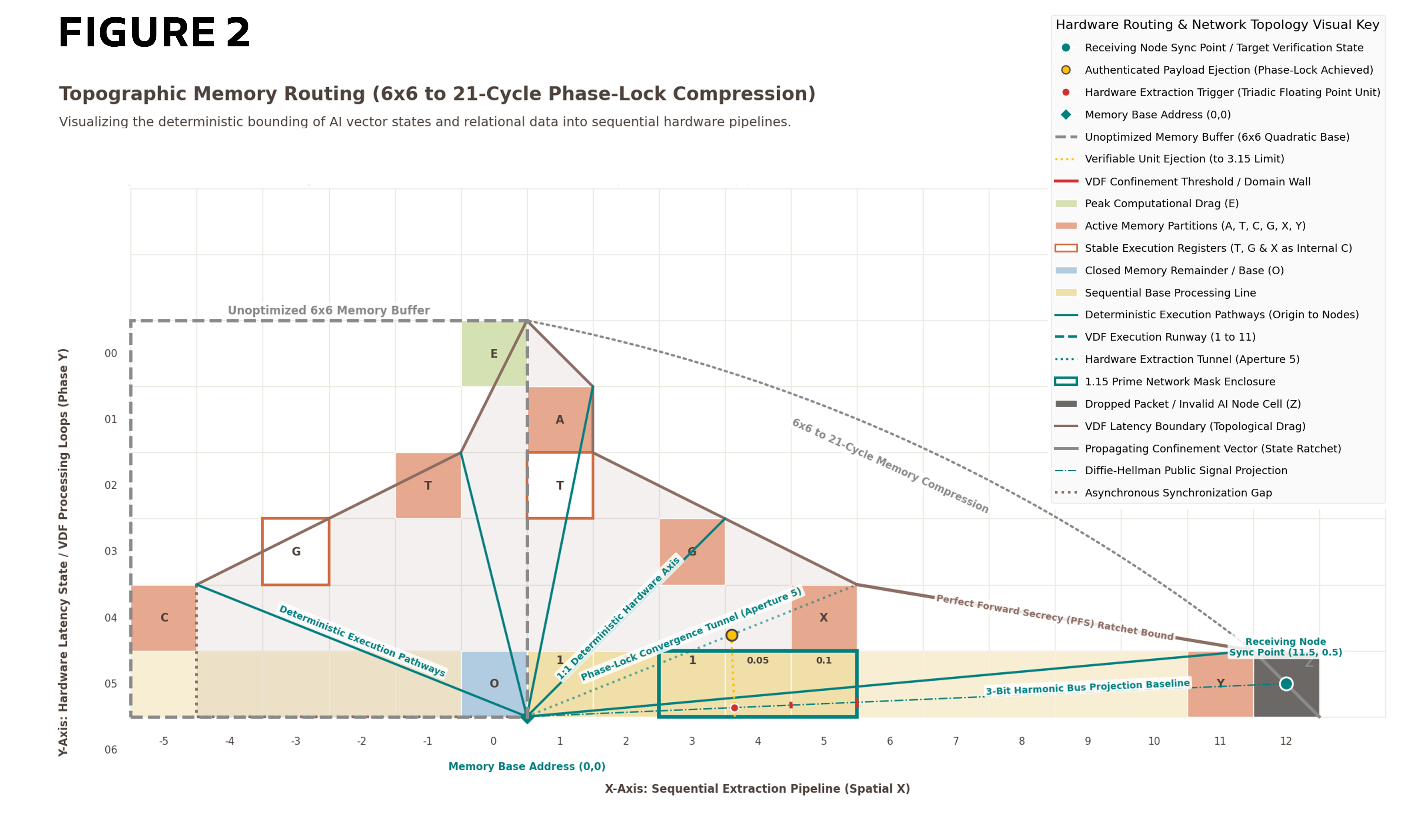
Plate F2. The geometric initiation of LDD, shown whole before any derivation: the 6×6 buffer, the drag boundary, the aperture, the partitions, the baseline walk to the (11.5, 0.5) point, and the 1.15 enclosure. Provenance: founded from the Holographic Indifference sheet of the living workbook — itself reached directly from the Dyadic Set Dynamics sheet, cells H130:CD155. Its registers have since been resolved by the named experiments (§11).
The record teaches in its own lifecycle order: the figure first, the resolution after (RK-15). The seed posited this geometry as a coordinate evolution 0 → 1 → 2 — total external constraint; the emergence of autonomy, with its oscillation read as the apparatus of an observable, communicable autonomy; and the incomplete closure at 2, obstructed at a Coordinate-5 "loose epistemic tunnel" and a Coordinate-11 "holographic delay boundary" — together with the remainder sequence 10][1][01, the eight absolute points (five constraining, three propagating), and the 1.15 bounding space (the ontological interrupt of 1.0 from 2 to 3; the holographic indifference limit of 0.15 from 3 to 3.15).
The cascade derives what the seed posited (RK-12). In the triadic loop (0,0) · (5,2) · (11,1):
- 5 = abs(E₄) and 11 = E₅ — the two obstructions to closure are the cascade's own fourth and fifth effects. The seed's coordinates are thereby retired as posits and kept as derivations.
- 11.5 = (2·11 + 1)/2 — the diode of the dyadic bus from (0,0) to (11.5, 0.5): E₅'s un-mirrored next step, halved, carrying the register shift (RK-13).
- The loop lengths are T = √29 + √37 + √122 and D = 2√132.5, with 5² + 2² = 29 and 6² + 1² = 37 — the observable square law of the surface, placing the primes in the geometry itself.
§7 · The instrument matrix — Plate F1
PLATE F1 — the transformation matrix (PNG, served beside this page)
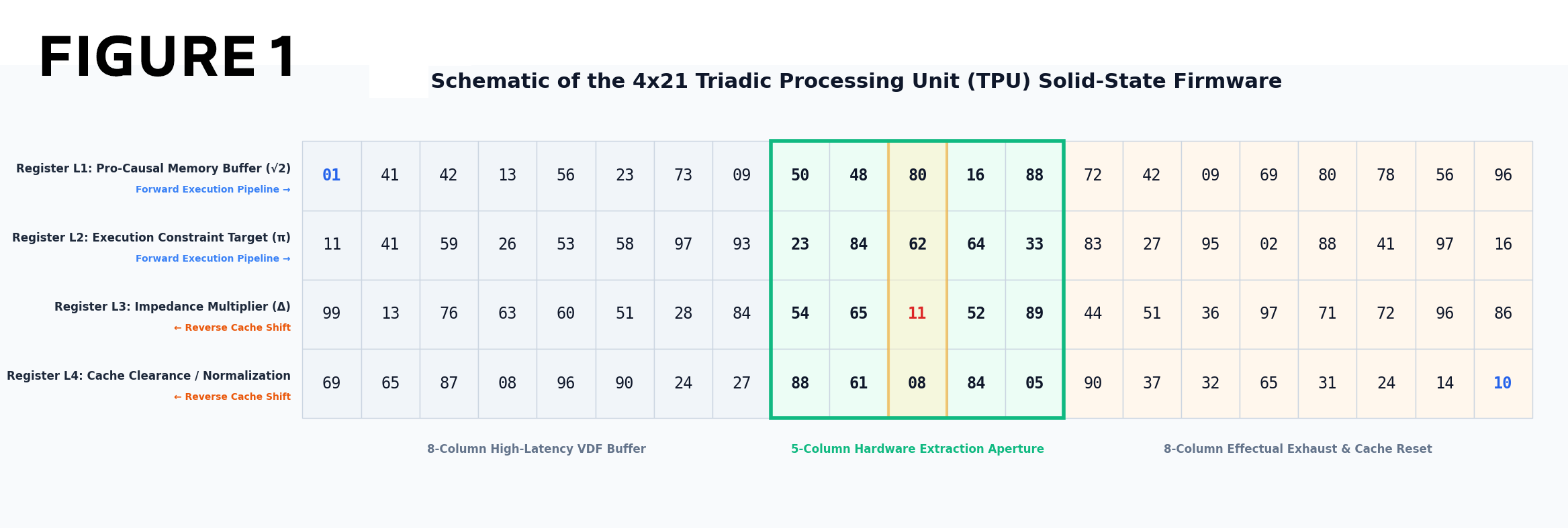
Plate F1. The transformation matrix. Provenance: founded from the Holographic Indifference sheet of the living workbook, beside Plate F2.
The claim this Reference makes for the matrix is a claim about origin (RK-14): from nothing but the assumption of linearity under strict confinement and the application of the conjectured 1 = O + C + E, such an instrument as the Figure-1 matrix can be formulated. It was not designed toward a use; it became knowable — and subsequently replicable and computable — from the first principles and methods native to LDD as operated in the field of applied Synthetic Set Dynamics. The workbook's founding cells, the Holographic Indifference sheet, and the two plates are one derivation surface; the matrix is what the surface yields when the confinement is held strictly.
The teachable reading of the instrument is a clock (RK-16): the matrix provides the manner by which state can ratchet forward in sync with the two-locks-one discipline (§9) as a discrete unit, local to two parties, carrying the differential payload of a change. It makes a clock that ticks as "there and then" only as "where and when" two parties also tick, via the prior synthetic agreement of the matrix. There is no universal clock in the framework (§9); the tick is real exactly where the agreement is, and nowhere else.
The matrix's usefulness in the subsequent experiments, and its applicability to cryptographic use cases in operational systems built on LDD, are notable — and secondary. They follow from the origin; they do not explain it. This Reference records the origin and leaves the applications to the records that operate them. It is noted, with this part of the reading, that the matrix is filed within a provisional patent claim (filing date 5 May 2026; Ref ID #2026904321), with applied use cases related to ontological addressability, low entropy computing and post-quantum cryptography — the filing recorded here as a matter of standing, the mechanics left where they operate.
§8 · Emergent constructs
The record's constants are epistemic constructs earned inside the record's own worlds — each observable, communicable and effectual within its declared apparatus, and none claimed beyond it. The discipline is one of sequence: the framework teaches the fit of the glove and never claims the hand; if the record's causal history one day speaks of emergent constants, it will be because constructs of this kind have come to speak for themselves, at two locks — never because a claim was made for them.
The principal constructs, each with the world that earned it:
- P = D/(D−T) = 45.27910… — the heartbeat: the quad period of the catch comb, computed from the derived geometry's own loop lengths (§6) and measured in the tenth experiment's record to 0.0007% (RK-17).
- 137 = ⌈1 + 3P⌉ — the emergent onset: exact in its world, measured as the bit-onset in the third experiment and carried as the fundamental throughout the record (RK-18).
- The floor 815/7 and the residual E∞ = 144/815 = 0.1766871… — the floor is 18D/(7(D−T)) as realized by the integer substrate; the residual is the permanent externality's own number: the fraction that never resolves into the verified interior. E is a running construct — 0 at the 2⁸ origin window, 0.1733 at the 2¹⁶ operational read, 144/815 at the limit — approached, never crossed (RK-19).
- The closure ±1 — the complete pro-causal run returns the unit: being(11) = 8·being(8) + 1 in the tenth experiment's ladder — the effectual chain closing back to 1 exactly (RK-20).
- The beat 1 = 0.75 + 0.25 — the substrate's measured equilibrium, the cascade's E* = 1/3 one octave down (§5).
Each line above names its world at the granularity of the experiment that earned it; the record behind each is witnessed at two locks (§9).
§9 · The disciplines
The framework's knowings are held by a small set of disciplines that are themselves part of the framework:
- Two locks one (RK-21). A single holding is a position; two agreeing holdings are a knowing. Every landed verdict in the record is witnessed twice — the account and its external anchor — and certitude is never claimed at one lock.
- The permanent externality (RK-22). The record never grounds itself: the zero is never claimed as ground (§2), the residual E is approached and never crossed (§8), and permanent claims are anchored outside the apparatus that produced them.
- The state-resolution doctrine (RK-23). There is no universal clock map, ever. Statements across engines, epochs or frames are typed state resolutions, and the record speaks in measures rather than in steps and rates presumed comparable.
- The seam-typing discipline (RK-24). Where a construct is found is not where it is: the record types the seam between frames and makes the epistemic-fit claim — this construct fits here, under this agreement — instead of the ontic claim.
- The concession, kept (RK-25). The record holds exact invariants and no conservation theorem. The concession was made once, honestly, and is never reopened by resemblance; kills and refutations are kept in the record with full standing beside what survived.
Two registers are held apart throughout: the static onto-epistemic (everything measured and derived in this Reference) and the lived and willed (intent and action), the second marked and never faked. And the fences hold everywhere: no physics; no claims outside the process license; supersession, never erasure.
A further note belongs to this section (RK-29). The record's non-engagement rulings — the subjects it refuses, the holds it keeps open rather than schedules, the claims it declines to make even when resemblance invites them — and its house conventions — seal before read; acts on explicit words; witnesses between acts; kills kept with full standing; naming acts reserved to their owner — are not etiquette around the work. They have themselves become composable yet load-bearing derivations of applied LDD: the framework applied to its own practice, optimizing co-constructively within an internally consistent synthetic agreement. A practitioner adopting the framework adopts these too, not as manners but as the dynamics that keep the record's knowings exact.
§10 · Participation = effect
The framework closes on its own institution (RK-26). In the OOI (the Objective Observer Initiative), the infrastructure supplies the first two terms — the observer experience renders participation observable; the social experience renders it communicable; the code experience anchors it verifiably — and the participant's act itself is the E: the effectual term no infrastructure can supply on its own. The pillars orient honestly on the zero of the conjecture, never claiming it as ground, and in that zero-calibrated accord the equation closes: O and C supplied, E enacted, the accord summing to 1.
This is the same closure the substrate itself measured at its final rung (§8), operating at the scale of an institution — the conjecture, enacted. The doors are open, and the framework's own account of why is co-constructive: each participant's effect is the unit's completion, theirs to bring.
§11 · Reading the Canon from the shot
Holding §§1–10, the experimental Canon reads as demonstrations. The series of ten, in order:
- The slip — the figure-2 slip on the (11.5, 0.5) geometry; the moving differential as the observable (RK-13, RK-15).
- The double slip — two independent slips read through the gap; the origin as a parameter: slip-differential relativity (RK-15, RK-23).
- The quad slip — four slips composed in three dimensions; the onset measured at 137 (RK-18).
- The hinge — two actors share the is; rate differences are effectual to the horizon; the separation is absorbed into the account (RK-9, RK-23).
- The double hinge — being × knowing at the fold; the coherent precision 4.23 as the ground's own readout (RK-9).
- The quad hinge — the fold in pairs is stable; the assurance primitive for federation (RK-21).
- The XOR gate — the gate raised from the a-priori with the sponge; the O/C/E witness bus, two pro-causal and one anti-causal (RK-2, RK-9).
- The XOR mirror — the origin "1" resolved by six back-propagating confinements; the residual E marked at the register boundary (RK-19).
- The being channel — the being read as a channel; the capacity band; the window relativity, peak × budget balancing at the 2⁸ octave (RK-11, RK-18).
- Co-constructive optimism — cooling read as structural emergence; the running E; the closure to ±1; the constructs of §8 measured end-to-end (RK-17, RK-18, RK-19, RK-20).
The applied campaigns, the dynamics in operation:
- The Wall Ladder — the held ladder; the campaign anchored externally, the record refusing to ground itself (RK-22).
- The Difference 1 Makes — the expansion fabric; cross-engine statements resolved as typed resolutions, the triangulation (RK-23).
- The Horizon Hypothesis — being, knowing and computing as epoch-confined linearities; seven sealed campaigns (RK-11).
- The Relativity Ingress Experiment — the constructed being-to-knowing diode read against externally named surfaces of uncomputed knowing, held as externalities and never as targets; the fossil law; and the dissolution: nothing interval-like binds across strata — each stratum keeps its own clock (RK-23, RK-24).
- The Matters Experiment — the first secondary formation on the ingress record, consumed only through its published surfaces: the direct-line coincidence unbroken at 208 of 208 while every received pattern proves local in exactly the dimension that widens — only the direct line predicts (RK-24, RK-27).
- The Notes Experiment — the note as a resolved-only (O, C, E) readout, readable only after resolution and composable by another micro-state; the duo law declared; the accumulator law exact across eight scales (RK-2, RK-9, RK-27).
- The Chords Experiment — the chord as a declared span read as one object; the tail law declared; interference and order shown real at the composed grain; a macro-region resolved as its own bounded object (RK-23, RK-27).
And the contributed walks, the disciplines under contribution:
- The Cornering Walk — the window rule; the stable residue signature under honest discreteness; the doorway curves; kills kept with full standing (RK-21, RK-25).
- The Looping Walk — the frozen inclusion; the corridor's structure-fixed signatures with their values data-supplied; the quarter as the 2×2 form's own exact ceiling; a kill kept beside a standing half (RK-21, RK-25).
Every campaign above is witnessed at two locks; the external anchors are listed in the references.
Two further layers complete the reading. First, the secondary epistemic formations (RK-27): from the applied campaigns were produced references to digital ontologies — the witnessed datasets anchored at mldata.opendata.ai — through which secondary matters and readings could become epistemic formations in their own right without ever re-running the primary record. The consumption discipline is strict: a successor consumes a record only through its published surfaces and witnessed anchors, never by import or re-run; the ingress family above is the discipline in operation, and the chronicle of these formations is kept in the workshop's own chain of progression.
Second, the readings as intentional externalities (RK-28): the reading surface's dialogues, papers and essays are placed as intentional externalities, each with a given figurative or explanatory license and a full explanatory declaration of its intent — points of ingress within the OOI. They are not the record; they are its declared doors: a reader may enter through a dialogue's staked wager, an essay's figure, or a paper's derivation line, and arrive at the same witnessed grounds this Reference states.
References
- De Costa, S. (2026). Linked Digital Dynamics — the living workbook. Google Sheets, public: the living workbook. The founding ranges: the Dyadic Set Dynamics sheet, cells H130:CD155; the Holographic Indifference sheet (the founding of Plates F1 and F2); the Natural Number Theory sheet (the differential classes of §5); Table 1: Linear Set Dynamics. Made public August 2026; represents citable works dating to earlier periods. A hash-pinned archived export of the founding sheets accompanies this Reference: the archived export (xlsx, the whole workbook as it stood at the mint) — sha256
ba44c3fa42df6b357e168f77dd47f9fa911a5a484f0983d90088d1e960f65402, exported 2026-08-06. - starl3n [De Costa, S.]. A Field Guide to Linked Digital Dynamics. The seed document (five pages): the conjecture's first statement, the Zero note, the posited geometry, A Tactical Conclusion, and the five founding experiments. Superseded by this Reference for citation.
- De Costa, S. (2026). The reading-surface papers. /sx/reading — the derivation-direction record of the experimental arc, principally the fifth paper (the corpora-wide account).
- The experimental record's external anchors (witnessed datasets, mldata.opendata.ai): walls-exp_19be23b1 · horizon-exp_6ec1e777 · rix-exp_7037eb09 · mtx-exp_52b4bb62 · ntx-exp_e4c9a847 · chx-exp_f16412dd · corner-exp_04e635ea · loop-exp_0c3892f5.
- The internal formal statement of Linked Digital Dynamics (the Atlas theory core), contemporary to the series of ten. This Reference is its public restatement.
Appendix A · The register of remarkable knowings
Standing: axiom (assumed and declared) · derived (exact consequence) · measured (earned in a declared world at two locks) · doctrine (a discipline of the record's own practice).
| RK | claim | standing | observable ground |
|---|---|---|---|
| 1 | 1 = O + C + E: reality for an observer sums observable, communicable and effectual | axiom | the workbook (NNT sheet); the seed, p. 1 |
| 2 | O, C and E are defined terms, not metaphors | axiom | the seed, p. 1; §1 |
| 3 | Zero is the non-differentiating boundary, void of net differentials over a confined periodicity | axiom | the seed (the Zero note); §2 |
| 4 | LDD claims only what the experimentalist's own process constructs (apparatus · ontology · agreement) | axiom | A Tactical Conclusion; §3 |
| 5 | LDD holds neither class nor type nor run of reason to be inherently superior or vital | axiom | the operator's resolution, 2026-08-05; §3 |
| 6 | Dyadic confinement: 1 = 0 under the orthogonal view, localizing by causal relativity | axiom | the seed, experiment 1; §4 |
| 7 | Triadic confinement: 1 = 0 + 0 (is and was) | axiom | the seed, experiment 2; §4 |
| 8 | Quadratic confinement: 1 = 0 + 0 + 0 (is, was, may) | axiom | the seed, experiment 3; §4 |
| 9 | The cascade rule: E → O as memory; O = C as presentism; E balances the unit | derived | §5; the NNT sheet |
| 10 | The E-sequence is the signed Jacobsthal sequence, abs(Eₙ) = (2ⁿ − (−1)ⁿ)/3 | derived | §5 |
| 11 | E* = 1/3, with O + C → 2/3 | derived | §5 |
| 12 | 5 = abs(E₄) and 11 = E₅: the closure obstructions are derived, not posited | derived | §6 (retiring the seed's coordinates) |
| 13 | The diode: 11.5 = (2·11 + 1)/2 carries the register shift | derived | §6; the slip |
| 14 | The Figure-1 matrix is formulable from linearity under strict confinement plus the conjecture alone | derived | the workbook chain (H130:CD155 → Holographic Indifference); §7 |
| 15 | Figure-2 is the geometric initiation whose registers the experiments resolved | doctrine | the plates; §6; §11 |
| 16 | The matrix clock ticks as there-and-then only as where-and-when two parties also tick, under the prior synthetic agreement | derived | §7; two locks one |
| 17 | P = D/(D−T) = 45.27910… — the heartbeat, earned by bracket | measured | the tenth experiment's record |
| 18 | 137 = ⌈1 + 3P⌉ — the emergent onset, exact in its world | measured | the third experiment; the tenth's chain |
| 19 | The floor is 815/7; E∞ = 144/815 — the permanent externality's residual, running and never crossed | measured | the tenth experiment's record; the eighth's marked boundary |
| 20 | The complete pro-causal run closes to ±1 | measured | the tenth experiment's record |
| 21 | Two locks one: a single holding is a position; two agreeing holdings are a knowing | doctrine | the witnessed record throughout |
| 22 | The permanent externality: the record never grounds itself | doctrine | §2; §8; every external anchor |
| 23 | No universal clock map, ever: cross-engine statements are typed state resolutions | doctrine | §9; the applied campaigns |
| 24 | Where-found is not where-be: LDD types the seam and makes the epistemic-fit claim, never the ontic claim | doctrine | §9 |
| 25 | The record holds exact invariants and no conservation theorem — conceded once, kept, never reopened by resemblance | doctrine | §9; the contributed walks |
| 26 | Participation = effect: the accord sums to 1 only with the participant's act | doctrine | §10 |
| 27 | The witnessed record, anchored externally, is a consumable digital ontology: secondary epistemic formations read the published surfaces and anchors, never re-run the primary | doctrine | the ingress family; the workshop chronicle; §11 |
| 28 | The readings are intentional externalities with declared intent: figurative or explanatory license generating points of ingress within the OOI | doctrine | the reading surface's grants; §11 |
| 29 | The non-engagement rulings and house conventions are composable, load-bearing derivations of applied LDD — co-constructive optimization within an internally consistent synthetic agreement | doctrine | the standing register; the kills kept; §9 |